
Why we will Prevail
Thoughts on my confirmation hearing, its aftermath, and what's next for the New Right

Yesterday, I chose to withdraw my candidacy for nomination as an Assistant Secretary of State. You can read the details of why I withdrew here if you’d like to.
But that’s not what this post is about. This is a post about what’s next, and why I think we should all be optimistic about it.
There’s a tremendous amount of political ferment in America right now, and that ferment brings both new challenges and new opportunities. Old orders and old certainties are melting away. In its place there will be many different ideological competitors— but I believe we have the truth on our side, and while I am not so naive as to think that truth automatically determines political outcomes, for both practical and moral reasons, I’d much rather have truth on my side than be forced to contend against it.
____________________________________________________________________________
A few days after my Senate confirmation hearing in February, I was contacted by the owner of a large and influential account in the New Right space (one with a six figure X follower count and an increasingly influential offline presence).
This was someone who, by his own description, had once been on the fringes of the online White nationalist right. He told me that The Unprotected Class was a “life altering” book for him that led him back to Christianity, away from political radicalization, and “towards reasoned politics.” While his note was particularly kind and flattering, especially coming from someone who was having a major effect on the current discourse, I had heard similar stories about my work from many others.
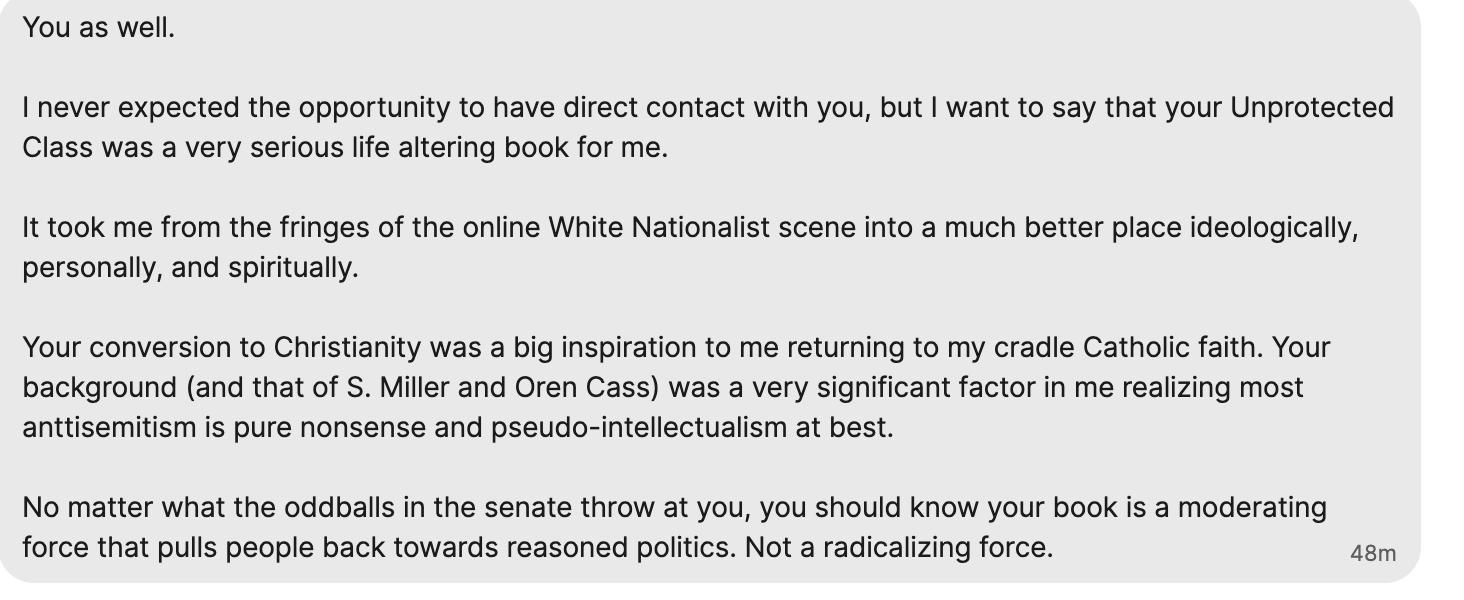
I agreed to accept the President’s nomination for this Assistant Secretary of State position, primarily of course, because I was interested in serving America and because I believed I could do a good job in the role. But I also stepped forward because I knew that my writings would be a public issue in my confirmation process, and because young men like this needed a voice. I have talked to hundreds of them with similar stories over the past few years. I wanted them to see through my experience and my candidacy that there was an alternative way for them to participate in the political process and address their legitimate concerns and interests in a way that avoided system-destroying radicalism, racial nationalism, or, even worse, political violence.
While the confirmation process was challenging, and I candidly did not expect my views on these issues to completely dominate my candidacy to the almost complete exclusion of my goals and ideas for the work I had wanted to accomplish in this position, I hoped I could be that voice-- not angry, but also unapolagetic.
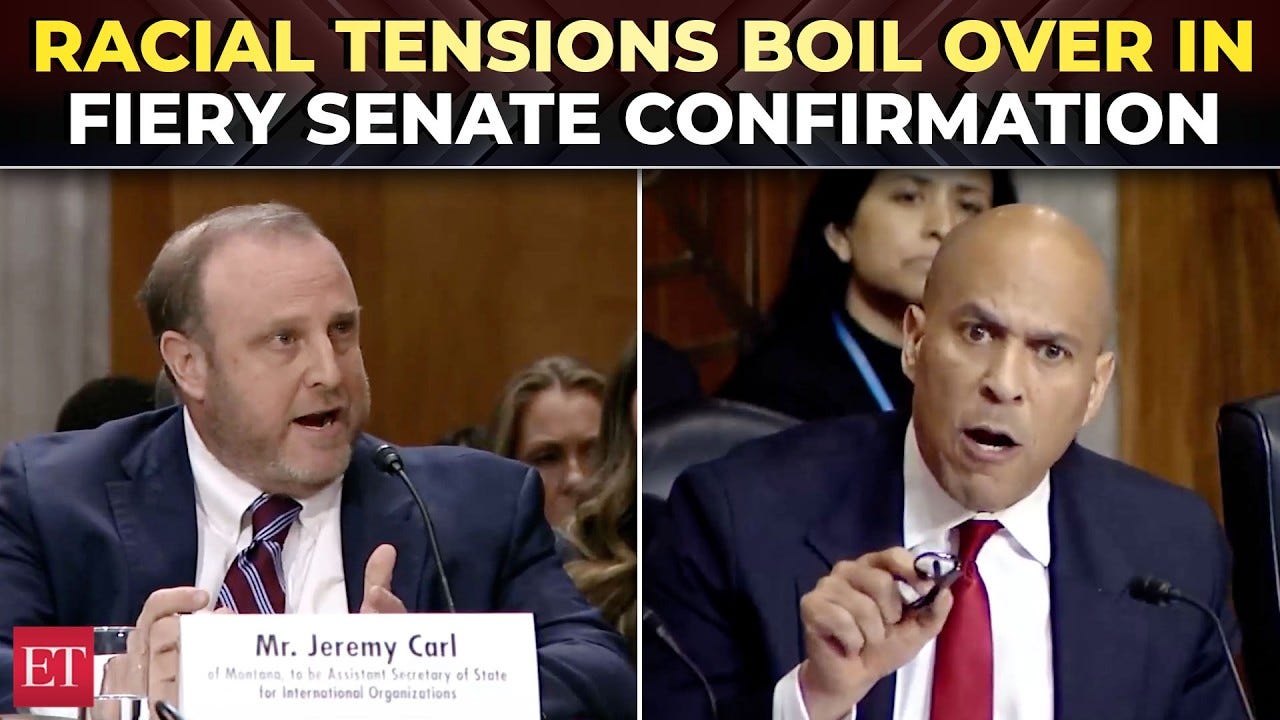
The over-the-top reactions of the Democrat senators and their allies were entirely predictable-- they were the desperate, dying spasms of a group that has for so long completely controlled the discourse in the area of race, privilege, and national identity. My very presence before their committee, and that they had not been able to stop me from getting as far as I did in this process, sent them into paroxysms of rage, rage that was evident to anyone who watched my confirmation hearing.
Candidly, the public response from the Republican Senators was largely somewhat disappointing-- but retrospectively, not that surprising. The average age of GOP Senators on the Foreign Relations Committee is 65 years old. None are younger than 50. They were raised in a very different America with far different demographics and a different discourse around these issues-- and one with a very severe set of punishments for those who did not toe the “acceptable” line.
A few of the Senators “got it” and were helpful, but overall, even those that meant well and were sympathetic were perhaps unsure how to best be publicly supportive, or whether doing so would be in their best interest, even though I suspect many know that the way we talk about these issues right now is badly out of sync with the views and experiences of our voters, in particular our younger voters of all racial and ethnic backgrounds.
And it was these younger voters, the students, not the faculty or other arbiters of “acceptable” opinion, who were the ones who have invited me to talk about my work, at Harvard, Notre Dame, Davidson and other similar schools over the past couple of years.
At the beginning of the last chapter of The Unprotected Class, I quoted the late Admiral James Stockdale, Ross Perot’s Vice Presidential running mate in 1992, a distinguished fellow at the Hoover Institution at Stanford and writer on political philosophy, and perhaps most importantly, a man who had survived more than seven years of brutal treatment in a North Vietnamese prison camp during the Vietnam War.

Stockdale observed, speaking of his many years in captivity, that “You must never confuse faith that you will prevail in the end—which you can never afford to lose—with the discipline to confront the most brutal facts of your current reality, whatever they might be.”
Without comparing the rather trivial challenges I faced to the horrors encountered by Stockdale, The brutal facts of our current reality is that, as my confirmation process shows, though we have made huge progress in opening up the discourse and changing anti-White policies under the leadership of President Trump, we still have a long way to go.
And yet, I am optimistic, thanks to the incredible support I’ve received from so many different quarters, from members of Congress, to federal agency heads to ordinary citizens, but most particularly from the young men and women of every background who will lead our party in the next generation.
And i’ve never been more confident that we will prevail in the end.
Onward!
We must prevail. Thank you for entering the arena. The rino gop gerentocracy doesn’t know what time it is, but younger voters do. Wishing you success in your next adventures. Stockdale is a great role model for all of us.
I’m old and completely concur with the statement about old Republicans. It’s nigh impossible to be honest especially with boomers and old Gen X.